







On 28 February 2026, the world changed overnight.
Joint US-Israeli strikes on Iran triggered one of the most significant geopolitical shocks in recent memory. Within hours, oil prices surged past $100 per barrel, shipping insurers suspended coverage through the Strait of Hormuz, and currency markets across emerging economies buckled under the pressure.
For most African business owners, the initial reaction was to watch and wait. This was a Middle Eastern story. A distant conflict. Not their problem.
But it is.
Why African Businesses Are More Exposed Than They Think
Africa is not on the frontlines of the Iran war. But African businesses are absorbing significant collateral economic damage through five channels that touch the daily reality of every importer, exporter, and cross-border operator on the continent.
- Your import bill just got more expensive
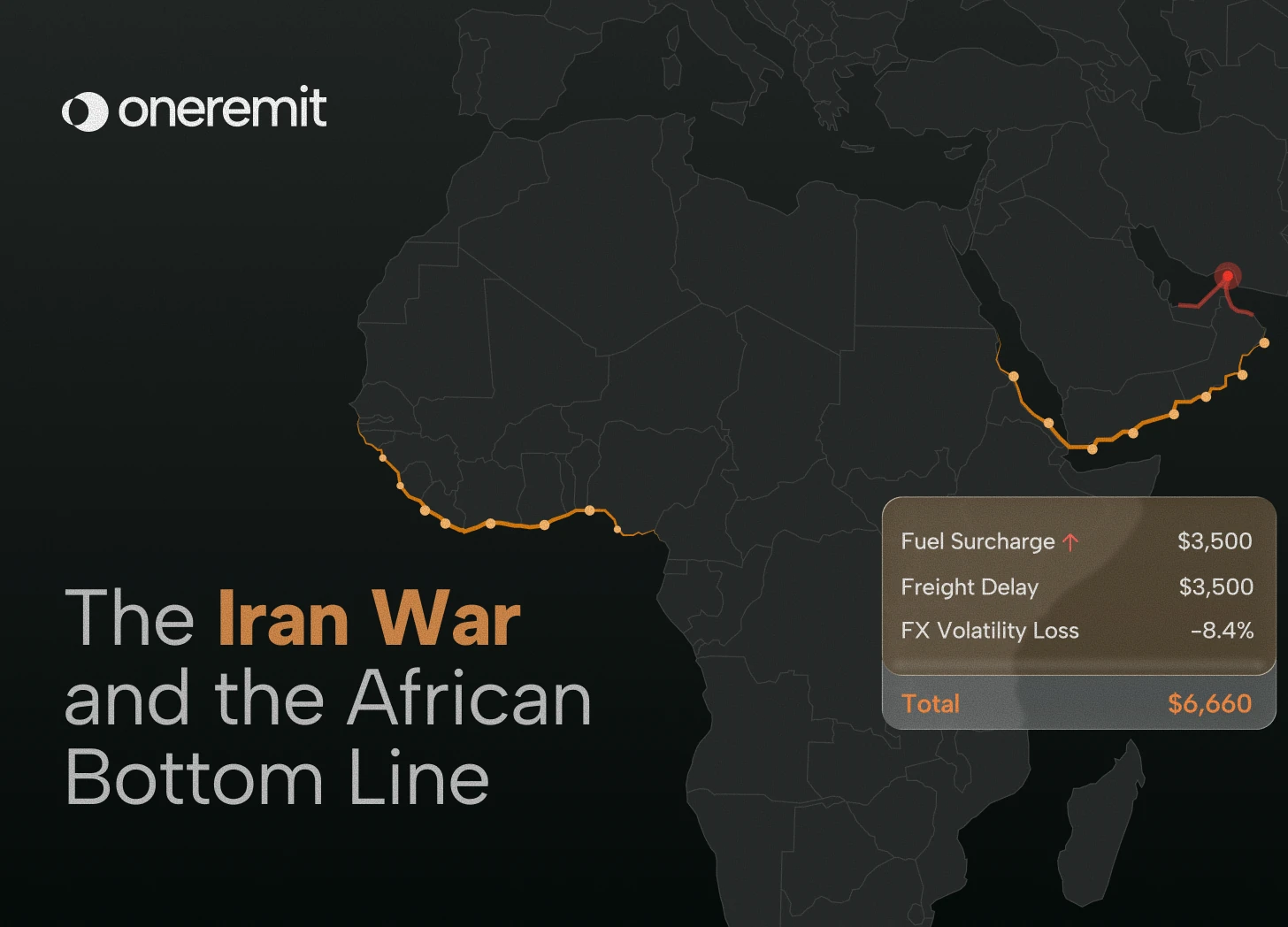
Most sub-Saharan African countries are net energy importers. With Brent crude well above $100 per barrel — reaching $120-$150 at its peak — the cost of fuel has increased sharply across the continent. That increase doesn’t stay at the petrol station. It moves through logistics, manufacturing, and raw material costs, embedding itself in every invoice your business pays internationally.
A Nigerian importer paying a European supplier in euros is not just absorbing EUR/NGN volatility. They are paying for a world where fuel, freight, and food costs have all moved against them simultaneously.
- The Gulf is more than a destination — it’s your transit hub
For many African importers and exporters, Dubai and Doha are not endpoints. They are the connective tissue between Africa, Asia, and Europe. A significant volume of goods moving between continents routes through the Gulf logistics infrastructure.
With airspace severely restricted, cargo capacity reduced, and shipping companies rerouting vessels around the Cape of Good Hope (adding 10 to 14 days to already strained transit times), that connective tissue is under serious strain. Goods that should have arrived this week may not arrive until May.
- Your food and agricultural input costs are rising
This may be less visible but equally consequential. The Gulf region supplies roughly 45% of sulphur traded globally, a critical input for fertiliser production. Sulphuric acid prices have risen 30% since the conflict began. For African agricultural businesses paying for inputs in USD, this is a direct cost escalation with no easy hedge.
- Your bank’s correspondent relationships are under pressure
Many African banks rely on Gulf-based correspondent banks for dollar access and international wire facilitation. With those institutions under heightened compliance scrutiny or operationally disrupted by the conflict, transaction processing times have lengthened, and rejection rates have increased for certain corridor payments.
In practical terms, transfers that used to clear in 48 hours are taking longer. Some are being rejected entirely. And the businesses bearing the cost of that friction are the ones waiting for payments to land.
- The exchange rate is moving — and it isn’t finished
Emerging market currencies are taking a disproportionate hit. The Egyptian pound has depreciated by more than 8% against the US dollar since the conflict began. The Zambian kwacha fell nearly 5%. The CFA franc dropped over 2%.
For African businesses, currency volatility is not a new experience. But the current environment adds a layer of unpredictability that even experienced operators are finding difficult to plan around. Locking in a rate on Monday could mean a significant loss by Friday. The window between committing to a payment and actually settling it has become genuinely dangerous.
What Smart Businesses Are Doing Right Now
The businesses that will emerge from this period in the strongest position share one characteristic — they are not waiting for geopolitical stability before making payment decisions. They are adapting their payment infrastructure to operate inside the disruption.
Specifically, they are doing three things:
Auditing their corridor exposure. Which of your payment routes touch Gulf-based banks, correspondent relationships, or logistics infrastructure? If you don’t know the answer, find out now — not when a transfer fails on a Friday afternoon.
Locking in FX at commitment, not settlement. If you are not locking in exchange rates at the moment you commit to a payment — rather than waiting until settlement — you are absorbing the full brunt of emerging market currency volatility in real time. In the current environment, that is an expensive habit.
Diversifying their payment rails. No single corridor, no single platform, no single currency route should be the only way your business moves money. The Iran war has made visible something that was always true: single-rail payment strategies are fragile. The businesses that have backup corridors are the ones still paying suppliers on time.
The Infrastructure This Moment Demands
The Iran war has not created new weaknesses in the global payments system. It has simply made existing ones impossible to ignore.
For African businesses, those weaknesses are compounded. Operating at the intersection of currency volatility, import dependency, Gulf logistics reliance, and limited correspondent banking access, pan-African enterprises are disproportionately exposed to exactly this kind of shock.
The response is not to wait. It is to build a payment infrastructure that is resilient by design: multiple corridors, transparent FX, fast settlement, and a partner who understands the specific realities of moving money from Africa to the world.
Oneremit was built for this environment. Not for the world before the disruption; for the world inside it. Multi-corridor routing across 100+ countries, real-time transparent FX, stablecoin-powered settlement for near-instant finality, and compliance-first architecture designed for African businesses operating globally.
Your suppliers still need to be paid. Your orders still need to move. Your business still has to run.
The world changed on 28 February. Your payment infrastructure should too, for the better.
Subscribe to our newsletter
for industry and payment insights